READING 15 · MATERIALS · THE HARDENING BRANCH
The Sum of Small Days
Every individual cycle is survivable. Fatigue is what happens when you count them all.
§ 01The arithmetic of tiny damage
A single road bump does not break an axle. A single pressurisation cycle does not split an aircraft fuselage. A single wave does not crack a ship's keel. Every one of those loads, applied once and removed, leaves the structure exactly where it was — the material elastic, the geometry unchanged, no permanent record of the event. Apply that same load a hundred times, and still nothing visible happens. A thousand times, a million times, and then — without warning, without progressive deformation, without the creep of impending doom — a crack appears from nowhere, and soon after that the part fails at a load it has survived effortlessly every single previous day.
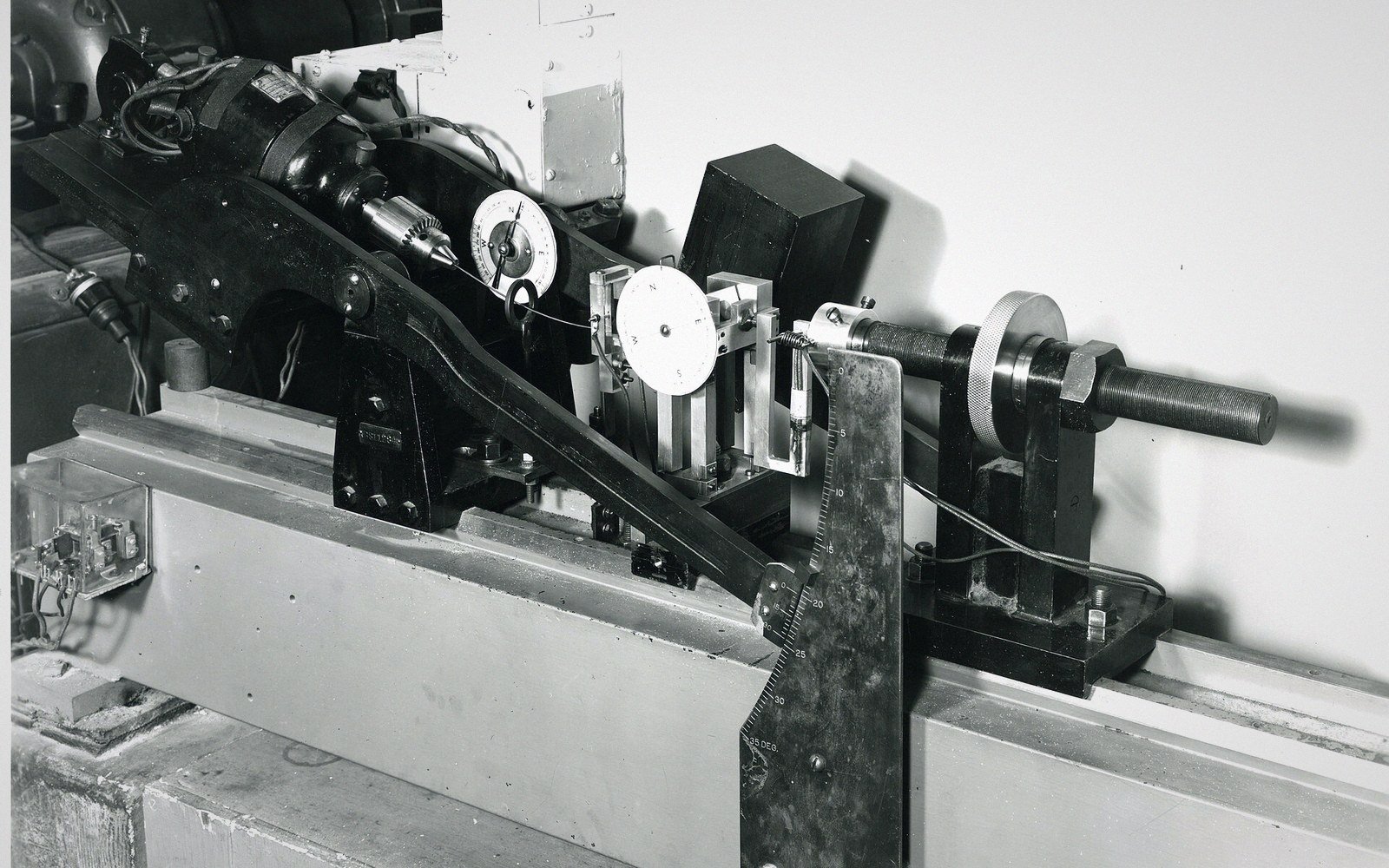
This is fatigue, and it is responsible for a large fraction of all mechanical failures in service. The mechanism has been understood in rough outline since the mid-nineteenth century, when August Wöhler began systematically breaking railway axles in his testing machine in Berlin and noticed that cycling a stress repeatedly to a level well below the static breaking strength would, in time, destroy the piece. His insight — that damage accumulates invisibly through repeated loading — is the foundation of every fatigue analysis done since.
What makes fatigue treacherous is exactly its ordinariness. The loads involved are not exceptional. Nothing unusual has to happen. The structure simply has to keep working, day after ordinary day, until the sum of those days catches up with it.
The shape of these curves encodes everything important about fatigue
§ 02How the crack comes
At the microscopic level, fatigue damage begins not with fracture but with plasticity. Even when the nominal stress in a component is below yield, local stress concentrations at notches, holes, surface scratches, grain boundaries or inclusions can push material at those points past yield on every cycle. Each time the stress rises and falls, the crystal structure at that point shuffles a little — a process called slip, in which planes of atoms move past one another. The first few cycles move them one way; reversed loading moves them the other way, but not quite back to where they started. The net result of millions of such micro-movements is the formation of a tiny intrusion or extrusion on the material's surface, a place where the structure is already compromised, where a crack initiates.
Once a crack exists — even one measured in micrometres — its behaviour changes the game entirely. The stress at the tip of a crack is not the average stress in the part; it is the average stress amplified by the crack geometry, a factor that rises with the square root of the crack's length. Every cycle extends the crack a little further, which amplifies the tip stress a little more, which extends the crack faster on the next cycle. This is stable crack growth, and for much of a component's life it progresses slowly enough that inspection can detect it. But as the crack grows, it is consuming what engineers call fracture toughness — the resistance of the material to the crack propagating suddenly all the way through. When the remaining cross-section can no longer carry the peak load, final fracture follows, and it follows fast. The fracture face of a fatigue failure records this whole history in its appearance: a smooth, beach-marked zone where the crack grew slowly, then a rougher zone of final overload — a two-chapter story of how the part spent its life and how it ended it.
How damage accumulates — the progression
- Crack initiationmicro-slip at stress concentrations, no macroscopic damage visible
- Stable crack growtheach cycle extends crack; beach marks form; detectable by inspection
- Critical crack lengthremaining cross-section cannot carry peak load
- Final fracturerapid, complete; fracture face shows two distinct zones
§ 03The Wöhler curve and its awkward middle ground
Wöhler's contribution extended beyond observation. He generated what we now call S-N curves: plots of stress amplitude (S) against the number of cycles to failure (N) for a given material tested under controlled conditions. The shape of these curves encodes everything important about fatigue. At high stress amplitudes, failure occurs in relatively few cycles — this is the low-cycle fatigue regime, where significant plastic strain occurs on each cycle and the damage per event is large. As stress amplitude falls, the number of cycles to failure rises, and the curve drops toward the right.
For some steels, Wöhler noticed that the curve flattened out: below a certain stress amplitude, specimens survived millions of cycles without failing. This apparent threshold — the fatigue limit, sometimes called the endurance limit — was taken for many decades as a true material property, a stress level below which no fatigue damage accumulated and infinite life could be expected. It shaped entire design philosophies. If you kept every stress cycle in service below the fatigue limit, the thinking went, your component would last forever.
The problem is that this is approximately true in some conditions, not universally true, and often dangerously optimistic. For many materials, particularly aluminium alloys, the S-N curve does not flatten — it continues to slope gently downward at very high cycle counts. There is no safe amplitude; there is only a lower rate of damage accumulation. Even for steels, the apparent fatigue limit can be undermined by environment: mild corrosion, even the presence of moisture, can eliminate the flat region entirely. A stress that would cause no damage in dry air, cycled ten million times, may initiate cracks when the same component is exposed to salt spray. The fatigue cracking mechanism in a corrosive environment operates differently — the passive oxide film that partly protects fresh slip faces is disrupted on each cycle, and the result is a continuous interaction between mechanical damage and chemical attack, sometimes called corrosion fatigue.
The practical implication is that the fatigue limit is a laboratory concept with a real-world caveat written on it in fine print.
Ideas worth pulling out of the flow
- "No single cycle is dangerous"the fundamental paradox of fatigue
- The fatigue limit as a laboratory concept with a real-world caveat
- Miner's rule: useful, known to be wrong, and used anyway with built-in conservatism
- Damage tolerance: the design philosophy that assumes cracks will exist
- Corrosion fatigue: how environment can erase the apparent fatigue limit
- Sequence effects: why the order of loading matters, and Miner's rule cannot capture it
§ 04Counting damage when cycles are not uniform
Real components do not experience tidy, constant-amplitude cycling. A vehicle suspension sees motorway cruise, speed bumps, potholes and emergency braking. An aircraft wing sees taxi loads, gusts, manoeuvre loads and pressurisation. An offshore platform leg sees wave spectra that change with weather. The question of how to add up damage from loads of different amplitudes and frequencies — how to convert a spectrum of real-world cycles into a predicted life — is one of the practical challenges at the heart of fatigue engineering.
The most widely used framework is the Palmgren-Miner rule, developed independently by Arvid Palmgren in the 1920s and later formalised by M.A. Miner in the 1940s. Its logic is straightforward: at any given stress amplitude, a component has a certain number of cycles to failure (read from the S-N curve). The fraction of that life consumed by n cycles at that amplitude is n divided by N. Sum the fractions from all the different load levels that occur in service, and when the total reaches one, the material is theoretically exhausted.
The rule is useful. It is also wrong in important ways, and the industry knows this. Miner's rule does not capture sequence effects: loading at a high amplitude early in a component's life may open a crack that then propagates faster under subsequent lower-amplitude cycles, a worse outcome than if the order had been reversed. The rule assumes damage accumulates linearly and independently, and real fatigue damage does neither with perfect fidelity. The consequence is that design codes using Miner's rule typically require the sum to be less than one — sometimes considerably less — as a conservative margin against the rule's own inaccuracy. The factor applied is, in a sense, compensation for a model that is known to be imprecise, not for uncertainty about the loads.
Chronology
- Mid-1800sAugust Wöhler begins systematic fatigue testing of railway axles in Berlin
- 1920sArvid Palmgren develops linear damage summation concept
- 1940sM.A. Miner formalises what becomes the Palmgren-Miner rule
- 1950s–1960saircraft accidents drive codification of damage-tolerance design philosophy
§ 05Why the failure looks sudden
One of the most disorienting things about fatigue, to the non-specialist, is the absence of warning. Static overload deforms things visibly before they break. Fatigue does not. For most of the crack-initiation and early-growth phase, the part looks and performs exactly as it always has. Deflections are normal. The structure carries its load without complaint. The crack may be growing steadily for years — measurable, if anyone is measuring — while the component functions without any outward sign of distress. The final fracture, when the remaining ligament can no longer carry the peak load, is typically rapid and complete.
This is why inspection intervals matter and why they are calculated, not guessed. The concept of damage tolerance — the philosophy underlying much of modern aerospace structural design, codified after a series of accidents in the 1950s and 1960s forced the issue — rests on the idea that cracks will exist, that their growth can be predicted, and that inspection must find them while they are still small enough that failure before the next inspection is not credible. The question the damage-tolerance framework asks is not will there be a crack but how fast will it grow, and how certain can we be of finding it in time.
The answer depends on material, geometry, load spectrum and environment — the same variables that govern fatigue life in the first place. But it also depends on the quality and frequency of inspection, on the probability of detection for a crack of any given size, on the conservatism written into the growth-rate model. Every day of safe service is an argument won against the arithmetic of small loads. The loads keep accumulating. The job of fatigue analysis is to understand, precisely enough, how many days that argument can last.