READING 16 · HOW IT BREAKS · PAST ULTIMATE
Ductile Overload
The honest failure: too much load through a material doing exactly what it said it would. What it leaves behind — necking, a dimpled surface, visible warning — and why it is the failure engineers prefer.
§ 01The failure that gives you fair warning
A ductile overload is almost a polite failure. The material takes load, deforms visibly, narrows, and finally separates — and at every stage it has been telling you what it is about to do. No sudden fracture, no flat brittle face, no ambiguity about what happened. Just a component that did exactly what its stress-strain curve promised, carrying load until it had nothing left to give.
Understanding why engineers treat this as the preferred failure mode — and what that preference actually costs in design — requires following the material through the full sequence of events.
The necked region identifies where the highest stress was
§ 02What happens, in order
When a ductile component is loaded past its elastic limit, it yields: the atoms in the crystal lattice begin to slip along favourable planes, and the material deforms without recovering. At this point nothing has broken. The component is softer than it was, and any further load is shared across whatever geometry remains. If the load keeps climbing, yield is not the end of the story — the material strain-hardens, briefly becoming more resistant to deformation before the geometry begins to work against it.
The critical transition is the onset of necking. To this point, deformation has been roughly uniform along the length of a tensile member; beyond the ultimate tensile stress, it concentrates. A region narrows faster than the rest because a tiny local imperfection — a surface mark, a slight variation in cross-section — draws more strain than its neighbours. The reduced area carries the same load with higher stress, which accelerates the narrowing. The process is self-reinforcing, and from this point the component's remaining life is measured in millimetres of elongation.
The fracture surface that results is diagnostic. At its centre, voids nucleate around small inclusions in the microstructure, grow and coalesce into a rough, fibrous, dimpled zone — the cup. Around the perimeter, a shear lip forms as the remaining thin wall of material shears at roughly forty-five degrees to the loading axis — the cone. The cup-and-cone fracture is so characteristic of ductile tensile overload that a failure analyst can confirm the mechanism at a glance, before any measurement is taken.
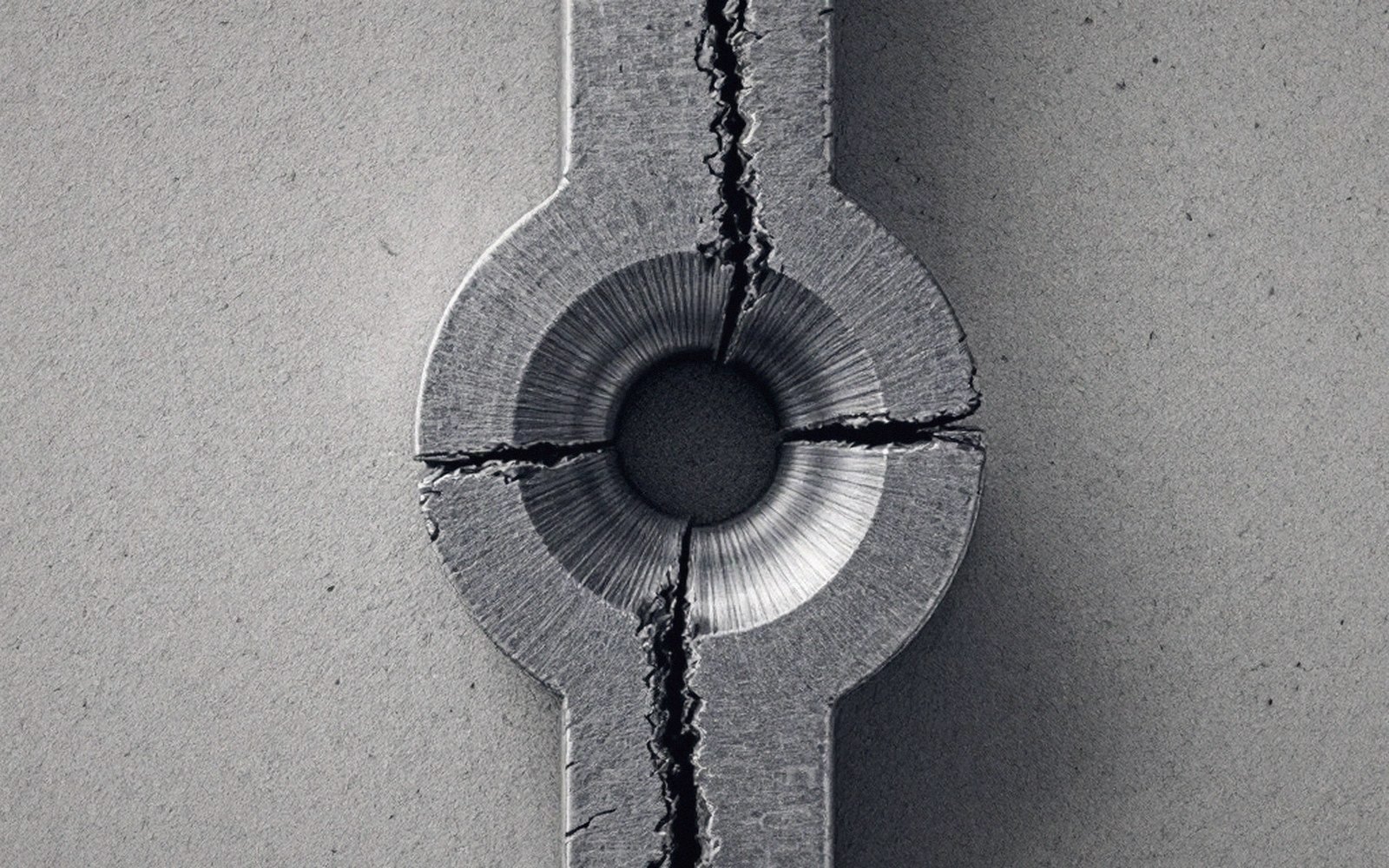
What the component leaves behind matters enormously in post-incident investigation. The elongation is permanent and measurable: you can see how far it stretched. The necked region identifies where the highest stress was. The dimpled surface records that the material was ductile at the time of failure, under these conditions, at this rate of loading. Every piece of that information helps establish whether the right material was used, whether the geometry was as designed, and whether the load was as expected.
What the fracture surface records
- Neckingthe local narrowing of cross-section that marks the onset of unstable deformation; visible and measurable after the event
- Cup-and-cone morphologythe characteristic ductile tensile fracture: fibrous dimpled centre (cup) surrounded by a 45° shear lip (cone); identifiable without instruments
- Dimpled fracture surfacemicrovoid coalescence around inclusions; microscopic signature of ductile overload, distinct from the flat, faceted surface of brittle fracture
- Shear lipthe angled perimeter zone; its presence and width give qualitative information about the material's ductility at the time of failure
What the failure mode trades
- Energy absorptionductile overload dissipates energy through plastic deformation; brittle fracture releases stored elastic energy instantaneously
- Warning timevisible deformation and necking precede fracture; the structure announces itself before separating
- Post-incident informationelongation, necking location and fracture morphology together allow reconstruction of what the material was doing; brittle fracture leaves a flatter, less legible record
§ 03Why engineers prefer it
The preference for ductile overload is not sentimental. It is structural.
A ductile component that is being overloaded absorbs energy as it deforms — the total area under the stress-strain curve up to fracture, which materials scientists call the modulus of toughness. That absorbed energy is time: time for the overload to be noticed, for an adjacent structure to redistribute load, for an inspection to catch permanent deformation before fracture. In a statically indeterminate structure, where multiple members share a load path, a yielding member effectively signals distress while the rest of the structure adjusts. The structure bends; it does not immediately collapse.
Brittle failure offers none of this. The material stores elastic energy right up to the fracture point and releases it instantaneously. There is no necking to see, no progressive deformation to measure, no warning in the minutes before. The distinction between these two behaviours — and why the same material can go either way depending on temperature, geometry and loading rate — is one of the more consequential things materials science has established in the last century.
This is also why the design preference for ductile materials in primary structure is not simply conservatism. It is a deliberate choice about the character of the worst case. An engineer designing a ductile structure is not assuming it will never be overloaded; they are choosing that, if it is, the failure will be visible and slow rather than sudden and total. The safety factor is not just a buffer against uncertainty — it is also a guarantee that if the buffer is consumed, something observable happens first.
The dimpled fracture face is, in this sense, the honest ending. The material did what ductile materials do. It deformed, warned, and then yielded everything it had. The engineering judgment that placed that material in that location was a judgment about which kind of failure was acceptable. A cup-and-cone fracture on the bench after an overload test is not a disappointment. It is confirmation that the reasoning held.