READING 5 · LOADS · THE ELASTIC REGION
Load Paths, and Where Force Actually Goes
Force doesn't distribute itself fairly. It finds the stiffest route, takes it, and leaves softer paths nearly idle — until something changes.
§ 01The Invisible Highway
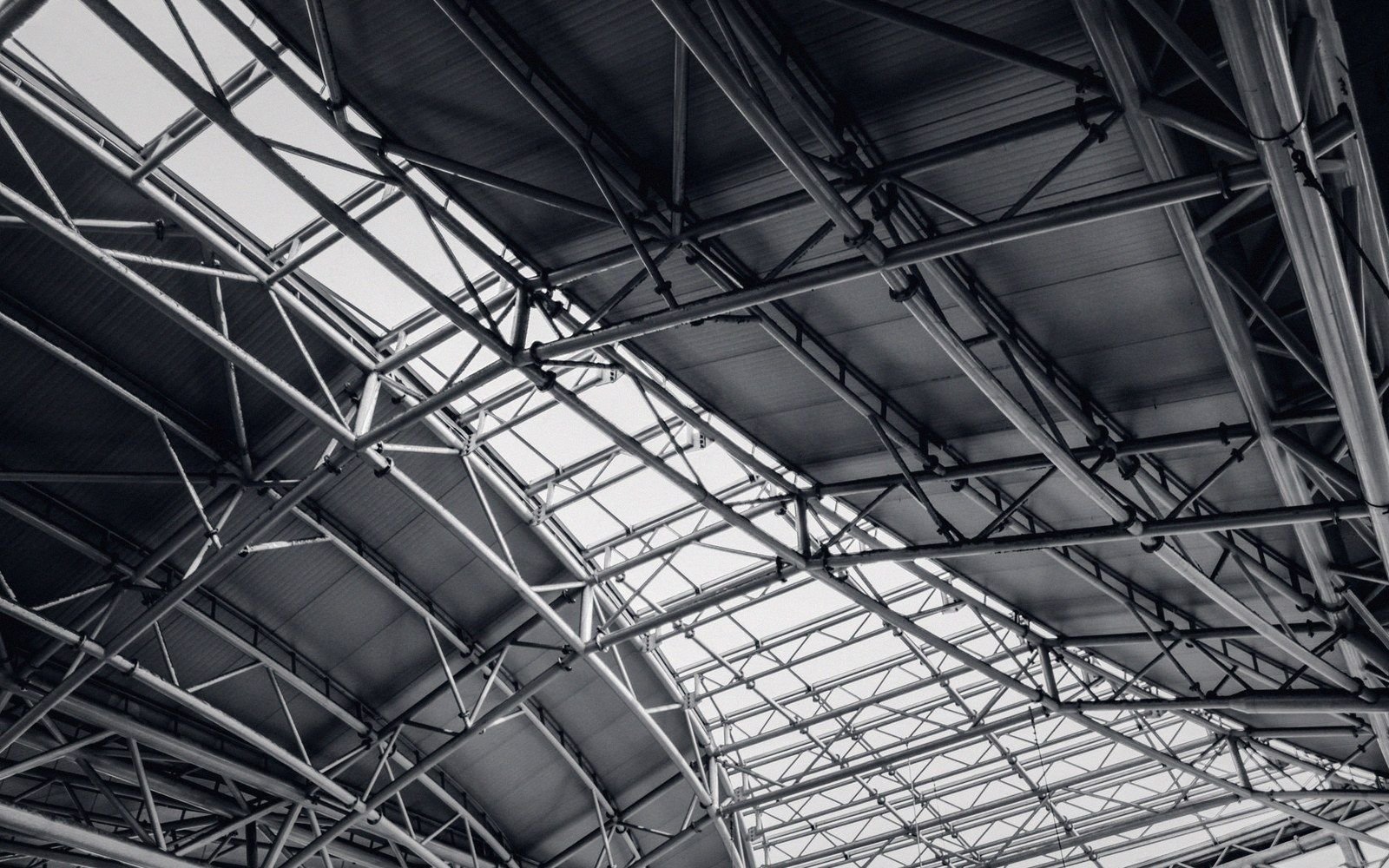
Every structure is a network of routes from applied force to ground. Call them load paths. The force doesn't spread evenly across all available material in the way water fills a tank; it flows preferentially, like current through conductors wired in parallel, gravitating toward whatever offers the greatest resistance to deformation. Stiffness, not strength, governs this preference. A stiff path attracts more load. A flexible path carries less. This is not intuition-friendly, because stiffness and strength often travel together in structural members — but they are not the same thing, and when they diverge, the load path reveals itself in ways that can surprise.
The principle has a clean statement in structural mechanics: load distributes in proportion to stiffness. In a system of parallel springs, the stiffer spring carries the larger share of the total force. Replace those springs with structural members — columns, beams, connections, welds — and the logic is unchanged. The stiff columns in a concrete frame attract more of the lateral load than the slender ones. The wider flange beam in a composite floor system carries more than its tributary area would suggest, while the narrow one beside it coasts. The force is not being generous or fair; it is being efficient.
Tracing a load path through a real structure requires following the geometry of stiffness, not the geometry of space. A load applied to a floor slab doesn't simply press straight down through the nearest column. It travels first to the nearest stiff path — the edge beam, perhaps, or the slab's own bending plane — and along that path to the connection, and then down through the column to the foundation. Each stage of that journey can be identified and, crucially, each stage can be overwhelmed or severed. When it is, the force doesn't disappear. It redirects.
A floor opening is cut larger than the drawings show
§ 02When the Path Is Blocked
The most instructive situations in structural engineering are not the ones where load flows smoothly to ground but the ones where something interrupts the planned route. A connection fails. A column is removed. A floor opening is cut larger than the drawings show. In each case, the load that was using that path still exists. Gravity has not been informed of the interruption. The force must now find the next-stiffest available route — and whether that route exists, and whether it can carry the load now asked of it, is the whole question of structural robustness.
This is the logic behind redundancy in structural systems: an alternate load path is not a luxury. It is the difference between a local failure that arrests itself and a progressive one that does not. What makes progressive collapse so dangerous — and what the analyses following Ronan Point in 1968 forced into the conversation — is precisely the absence of alternate paths. Remove a panel, and the load that panel was carrying must go somewhere. If the only somewhere is the next panel down, the failure propagates. The structure has no capacity to shed load laterally, to transfer it to elements that are still standing.
The mechanism is straightforward but the practical implication is not always well understood: a structure can have enormous strength in its primary members and still be catastrophically brittle as a system, because strength in individual members is not the same as redundancy in the path network. A single highly-loaded column with no alternate route is a liability regardless of its factor of safety, because when it fails — for whatever reason — the load it was carrying arrives somewhere else all at once, and that somewhere else has not been designed for it.
Where the force actually ends up after a path is interrupted depends on geometry and relative stiffness in the surviving system. The answer is often not where intuition points. A column removal near the middle of a long floor bay will, in a frame with moment-resisting connections, attempt to mobilise the floor as a catenary — essentially converting the floor beam into a hanging cable, with large horizontal tension forces pulling inward on the columns above. Those columns must now resist an inward horizontal pull that was never in the original load case. The load has travelled sideways and upward in a way that a purely vertical-thinking analysis would have missed entirely.
Load path concepts
- Load paththe route a force travels from its point of application through the structure to the ground
- Stiffness-governed distributionforce concentrates in stiff members; flexible members carry proportionally less, regardless of strength
- Alternate load patha secondary route available if the primary path is severed; the presence or absence of one defines whether local failure stays local
- Catenary actionwhen a beam or floor is pulled into tension after support loss, horizontal forces are generated in the supporting structure that may not appear in the original design load case
- Progressive collapsea cascade where local failure removes a path, overloads the next, and so on; Ronan Point (1968) is the canonical case that changed how codes treat robustness
What changes a load path
- Temperaturerestrained thermal expansion creates axial forces that must find their own route to ground
- Settlementdifferential column settlement shifts relative stiffness and silently reroutes load
- Creepsustained stress causes concrete to redistribute moment over time, moving load away from originally stiff zones
- Damagepartial failure of a connection or member changes the stiffness map immediately, redirecting force to surviving elements
- Connection behaviourreal connections are neither perfect pins nor perfect rigid joints; their actual stiffness governs how moment and shear divide
§ 03Stiffness Changes, and the Path Moves With It
One reason load paths are not fixed is that stiffness is not fixed. Temperature, damage, differential settlement, and time all change the stiffness distribution of a structure, and as they do, they silently reroute the loads. Concrete creeps under sustained stress, gradually redistributing moment in a continuous beam from the stiffer zones toward the more flexible ones. A column that settles slightly relative to its neighbours becomes less stiff in the system's terms and sheds load to them. Thermal expansion in a restrained member generates axial forces that were not there at ambient temperature, forces that must find their own path to ground.
This dynamic quality is what makes load-path thinking necessary at the design stage rather than optional. A structure designed to carry loads through one intended path — and detailed accordingly — may not survive the redistribution that follows any significant change in its stiffness map. The welds and connections that seemed adequate for the designed load share may be woefully short for the accidental one. The coupon tells the truth about the material, but the material's performance is also a function of what load it is actually seeing, and that depends on a system-level stiffness picture that no single test bar can represent.
There is a further complication: joints and connections are often the most stiffness-critical parts of the path, and they are also the most geometrically complex. A bolted connection has a stiffness that depends on bolt pattern, plate thickness, and the precise sequence in which the bolts engage — which may differ under different load directions. A welded joint is stiffer than a bolted one in certain directions and equally so in others. Whether a beam-to-column connection is genuinely moment-resisting or effectively pinned determines whether load travels through it as a couple or simply as a shear — a choice that changes the forces in every connected member. Idealisations made for calculation convenience are always approximations; real connections sit somewhere on a spectrum.
The practical discipline this imposes is a habit of mind rather than a procedure. It is asking, at each step of a structural analysis, where the force actually goes rather than where it was intended to go. It is asking what happens to the load path when one element is taken out, whether the remaining system has a coherent alternative route, and what the secondary and tertiary effects of that rerouting are. These are not exotic questions reserved for progressive-collapse analysis. They are the normal questions of anyone trying to understand a structure rather than simply calculate it. The line a force draws through a building from point of application to foundation is the most fundamental thing about that building. Follow it, and the structure makes sense. Ignore it, and the structure will eventually make the point itself.