READING 22 · WHERE THE NUMBERS COME FROM · THE AXES THEMSELVES
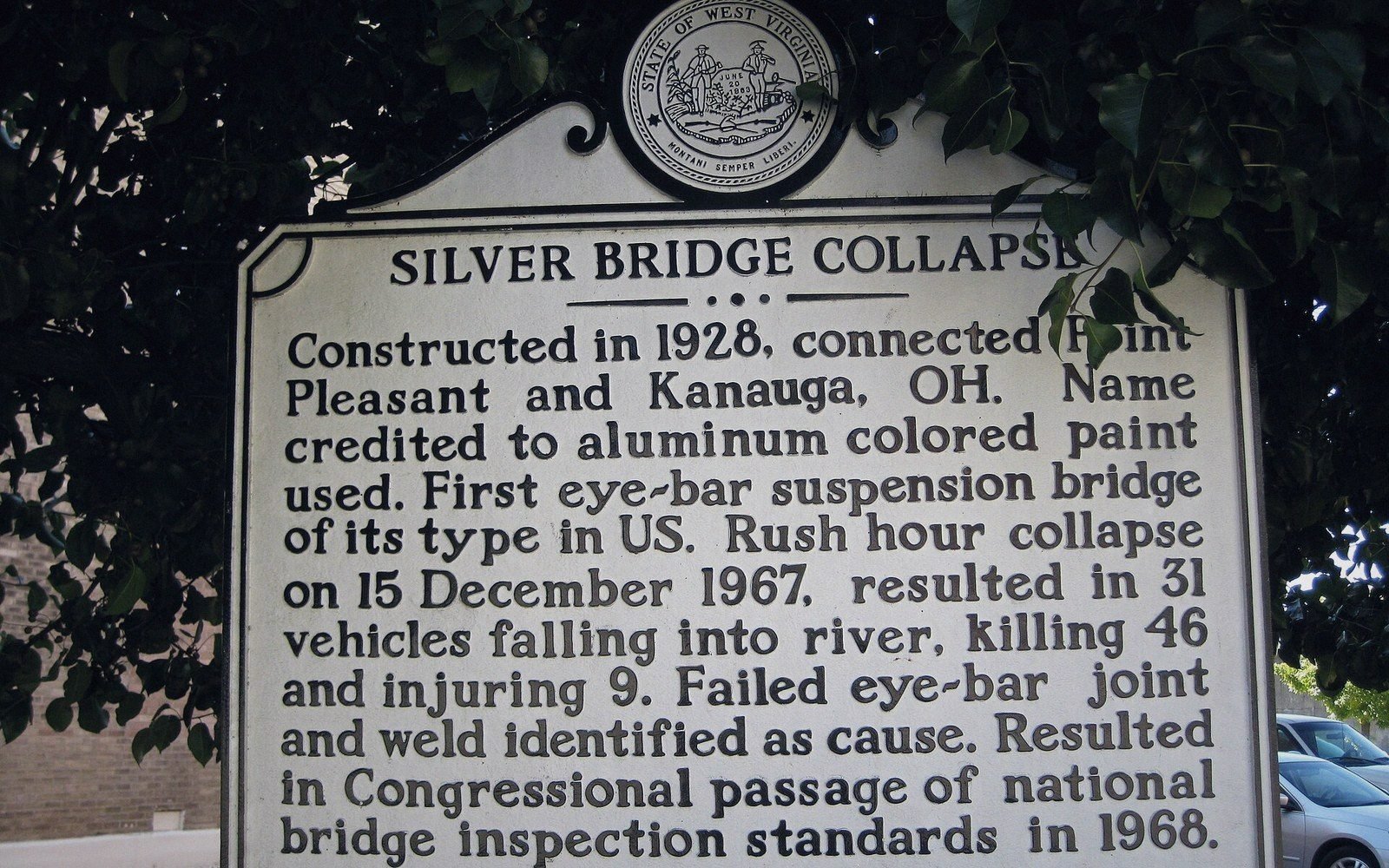
What the Silver Bridge Changed
One eyebar out of hundreds, one crack a few millimetres deep, and the reason every highway bridge in America is now inspected on a schedule. The 1967 collapse at Point Pleasant forced two changes: mandatory inspection, and the phrase 'fracture critical'.pse at Point Pleasant told soberly, and the two changes it forced: mandatory inspection, and the phrase 'fracture critical'.
§ 01A structure that trusted every part equally
The Silver Bridge carried US Route 35 over the Ohio River between Point Pleasant, West Virginia, and Gallipolis, Ohio. It opened in 1928 and was, at the time, a creditable piece of American engineering: an eyebar-chain suspension bridge, a form that had proven itself across the country through the early decades of the twentieth century. The chains were made of flat steel bars with a circular eye forged at each end, pin-connected into a continuous chain that carried the deck below. Each bar worked in tension, each pin transferred load between adjacent bars, and the whole system was elegant in the way tension structures often are — steel doing exactly the one thing steel is best at.
What the designers understood, and what the inspection regime of the era took for granted, was that redundancy was present in the usual sense: there were many bars, many links, many pins. If one element softened, others would carry more. This is the logic behind most structural systems — the assumption that no single component is the only route by which load can travel.
The eyebar chain of the Silver Bridge did not work that way. Each chain was, effectively, a single load path. If any one bar failed, the chain failed. If the chain failed, the bridge failed. This fact was not secret or obscure — it was simply not framed as a particular vulnerability in the language that engineers or inspectors were using in 1967. There was no category for it yet.
The eyebar chain of the Silver Bridge was the paradigm case
§ 02What happened, and what caused it
On the afternoon of 15 December 1967, during rush hour, the Silver Bridge collapsed into the Ohio River. Forty-six people died. The investigation that followed was thorough and took time, because the wreckage had to be recovered from the river and reconstructed on land before it could be read.
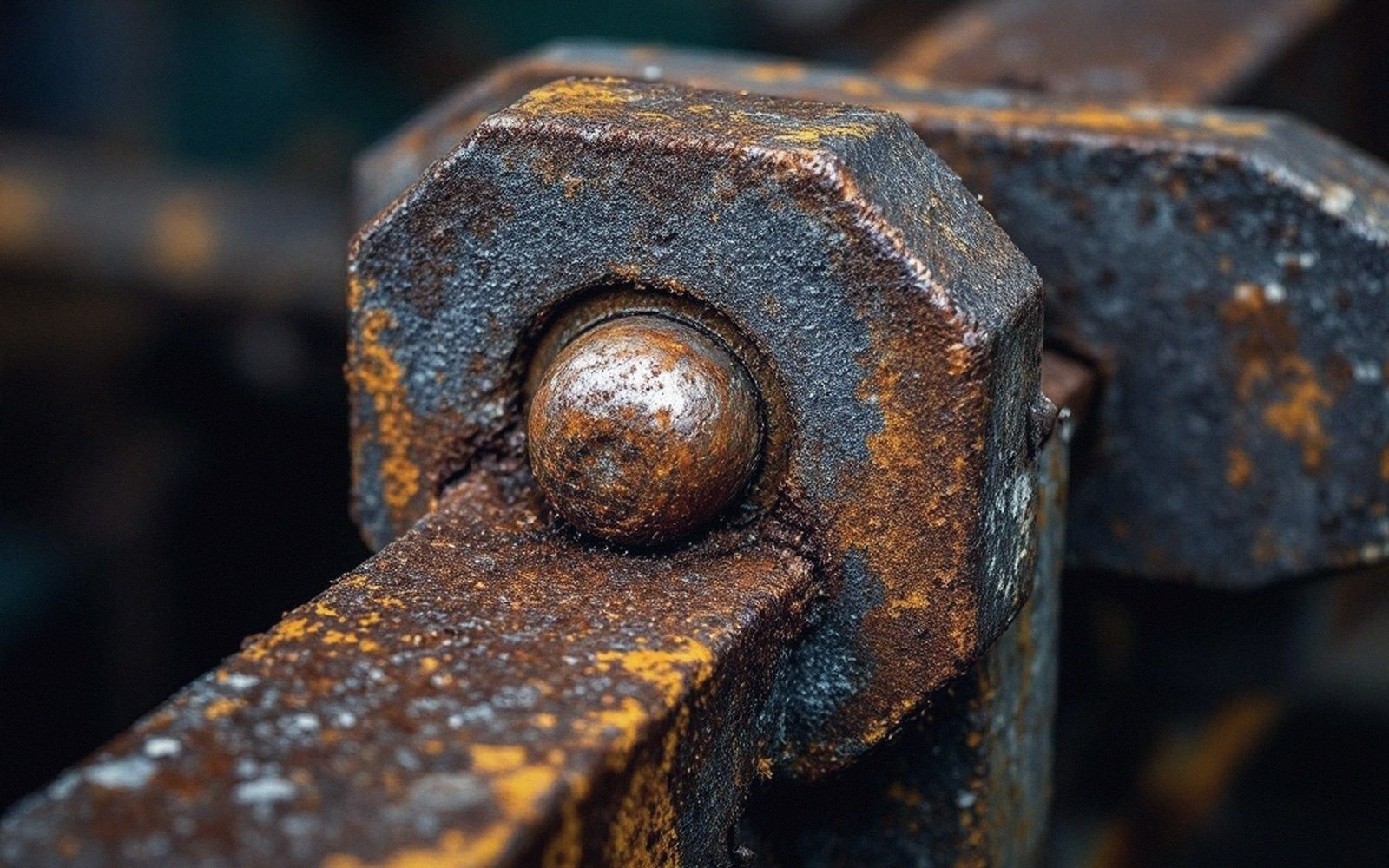
What the investigators found, eventually, was a stress-corrosion crack in a single eyebar — eyebar C13, on the north chain, near the Point Pleasant anchorage. The crack was small: a few millimetres deep, originating at a corrosion pit at the tight interface between the eyebar eye and the pin. The bar was under sustained tension. The environment provided moisture and a mildly corrosive chemistry. The geometry concentrated stress at the pit. Over years, the crack grew — slowly, invisibly, in a location that was essentially inaccessible to visual inspection. When it reached a critical size for the material and the stress level, it propagated without warning.
That progression — a surface pit becoming a crack, the crack growing under stress-corrosion cracking mechanisms rather than simple fatigue — is what made the Silver Bridge failure so clean as a forensic case. There was no traffic spike, no overloading, no sudden event. There was a normal December afternoon and a crack that had grown past the point of no return.
Because the chain had no redundancy, there was no arrest. The adjacent bars could not pick up the load; the geometry of the chain meant that losing one bar was losing the path. The collapse was, in that sense, inevitable from the moment the crack reached its critical size — and nothing in the inspection regime of the period would have caught it beforehand.
The forensic timeline
- 1928Silver Bridge opens, US Route 35, Point Pleasant, WV to Gallipolis, OH
- 15 December 1967collapse during rush hour; 46 fatalities
- Post-collapsewreckage recovered from Ohio River and reconstructed on land for investigation
- Findingstress-corrosion crack in eyebar C13, originating at a corrosion pit at the eye/pin interface
- 1971National Bridge Inspection Standards come into force (US Federal Highway Administration)
Structural concepts worth pulling out
- Eyebar-chain suspension bridgetension chain of flat bars with forged eyes, pin-connected; each chain a single load path
- Redundancy vs. single-load-pathwhy the absence of alternate paths made a single-bar failure terminal
- Fracture-critical membera term the Silver Bridge made necessary: a steel tension component whose failure would cause collapse and which has no redundant path
§ 03The two things that changed
The United States Federal Highway Administration launched a national bridge inspection programme in the aftermath of Point Pleasant. Before December 1967, there was no federal requirement for systematic, scheduled inspection of highway bridges. Bridges were built, opened and left to the management of individual states without a uniform inspection standard or inspection interval. The National Bridge Inspection Standards, which came into force in 1971, changed that. They established inspection frequency requirements and set out what a bridge inspection had to cover. The number of bridges across the country that had never been formally inspected was, when the programme began, substantial.
That change was administrative and organisational — a recognition that structures deteriorate and that deterioration is only visible to someone who looks. It was not a small change. The programme created a national inventory of highway bridges and a mechanism for tracking their condition over time.
The second change was conceptual and has lasted longer in the language of structural engineering. The Silver Bridge introduced — or more precisely, forced into clarity — the idea of the fracture-critical member. A fracture-critical member is a tension component of a steel bridge whose failure would be expected to cause partial or total collapse of the structure, and for which there is no redundant load path. The eyebar chain of the Silver Bridge was the paradigm case.
The definition matters because it changes what inspection means. A bridge with abundant redundancy can tolerate a crack growing in one member without immediately threatening the whole; there is time, and there are paths. A bridge with a fracture-critical member has neither. The inspection standard for a fracture-critical member must therefore be more rigorous, more frequent, and capable of finding cracks that are not visible from a walkway. This is why fracture-critical bridge members require hands-on inspection — inspection close enough to see surface condition, not just general geometry — and why the interval between those inspections is set as it is.
The phrase itself, and the category it names, did not exist in structural engineering before the Silver Bridge made it necessary. It is one of those cases where a failure supplied a vocabulary that practice had lacked. Once the category existed, engineers could look back at other structures and ask which of their members met the definition, and therefore which required the inspection treatment the Silver Bridge had shown was non-negotiable.
§ 04What it tells us about how limits evolve
The Silver Bridge is not a story about bad steel, bad design or inadequate safety factors in any simple sense. The allowable stresses of the original design were consistent with the practice of the era. The steel met what was specified. The failure happened in the gap between the design assumptions and a degradation mechanism — stress-corrosion cracking at a constrained, invisible location — that those assumptions did not account for.
What changed after 1967 was not primarily the calculation of strength. It was the recognition that a structure's margin is not purely a function of its original specification. A margin erodes. It erodes through corrosion, through fatigue, through mechanisms that work slowly and out of sight. The only way to know where the margin currently stands is to inspect — and to inspect with tools and frequency matched to the specific vulnerability of the specific structure.
The fracture-critical designation is, in this sense, a formalised acknowledgement that some structures carry their risk differently from others, and that the inspection regime has to reflect the failure mode rather than simply the age or size of the bridge. The Silver Bridge gave that idea its permanent address in American bridge engineering.